
Supporting Local Heroes: Special Savings Available For Veterans & First Responders
DIY Ice Dam Removal Risks
Should You Try to Remove an Ice Dam Yourself
The Short Answer
DIY Ice Dam Removal Is Not Recommended, and Here Is Why
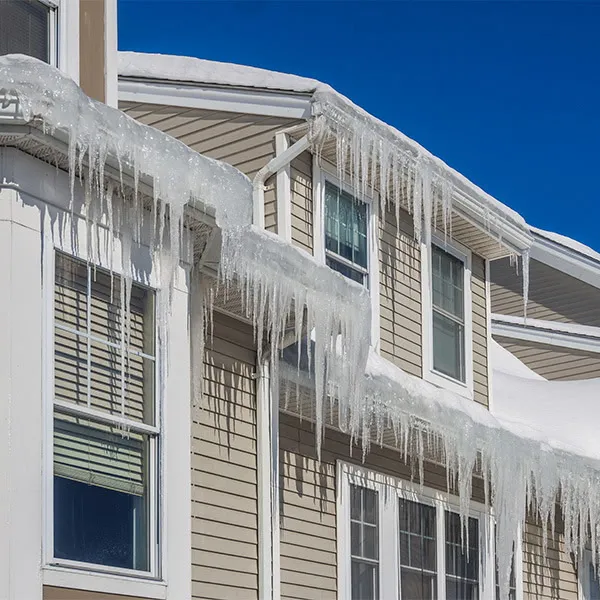
Removing an ice dam yourself is one of the more commonly attempted winter home repairs, and one of the more likely to make the situation worse. Chipping or hammering at ice on a roof can crack or tear shingles that were otherwise fine, and it can pull gutters loose from the fascia if the ice being broken up is attached to them. Winter roofs are also genuinely dangerous to be on, with ice underfoot, uneven footing, and a fall risk that increases significantly compared to working the same roof in summer. Salt based ice melt products, a common DIY fallback, can stain roofing materials and corrode metal flashing and gutters over time. The safer and generally more cost effective route is a professional removal that clears the ice without creating new damage in the process.
Special Savings Offer
Get Your Free Estimate & Safeguard Your Property Today
Why DIY Ice Dam Removal Backfires
What Actually Goes Wrong When Homeowners Try This Themselves
Most DIY ice dam attempts are not reckless, they are a reasonable response to an urgent looking problem with limited information about what is actually safe to do. Understanding the specific ways this goes wrong helps explain why professional removal exists as a distinct service rather than a task any homeowner with a ladder can safely do.
Physical damage from chipping and hammering
Cracked or torn shingles: Ice is often bonded tightly to the shingle surface, and breaking it loose with force frequently takes granules or entire shingle tabs with it.
Damaged flashing and seals: Aggressive removal near valleys, vents, or chimney flashing can crack seals that were otherwise intact, creating a new leak point where there was not one before.
Gutter damage: Ice frozen into a gutter section is often chipped away along with the gutter's structural integrity, since the two are effectively bonded together.
Fall and safety risk
Ice underfoot on the roof itself: A roof that already has ice buildup is inherently more slippery than a dry roof, and that risk applies to the areas around the ice dam as much as the ice itself.
Ladder instability on frozen ground: Setting up a ladder on snow or ice covered ground adds a fall risk before a homeowner has even reached the roof.
Limited visibility of ice extent from the ground: It is difficult to judge how thick or extensive an ice dam actually is without being close to it, which can lead to underestimating what is being worked on.
Chemical and material risks from ice melt products
Salt based melters staining shingles: Rock salt and similar products can leave visible staining on asphalt shingles that does not go away once the ice melts.
Corrosion of metal components: Salt based products can accelerate corrosion on metal flashing, gutters, and fasteners over repeated seasonal use.
Runoff affecting landscaping: Melted ice carrying salt runs off into gutters, downspouts, and the ground below, which can affect nearby plants and lawn areas.
How Elevation Exteriors Removes Ice Dams Without Creating New Damage
A professional removal uses methods and tools suited to breaking up ice without attacking the roofing material underneath it, and the crew is equipped and trained to work safely on a winter roof in a way a homeowner with a ladder generally is not. The goal on every call is removing the ice completely without leaving behind new shingle, flashing, or gutter damage that then has to be repaired separately. See our ice dam removal process.
Process
Our Ice Dam Removal Process
Step 1: Contact Our Team
Call or fill out the form. We'll assign you a dedicated point of contact and get you scheduled quickly.
Step 2: Detailed Property Assessment
We inspect the ice buildup, roof condition, and interior damage, and identify what's causing it.
Step 3: Review Your Estimate
Our estimates are free, accurate, and designed to make the entire process pain-free! Your designated project manager will walk you through each line item, ensuring all of your questions are answered in-depth.
Step 4: Removal & Repairs
Our crew safely removes the ice and makes any needed repairs. You'll get text updates the whole way.
Step 5: Clean-Up & Prevention Plan
We leave your home clean and give you a plan to help prevent ice dams from returning.
FAqs
Common questions Your Neighbors Are asking
Is it ever safe to remove a small ice dam myself?
Even a small ice dam carries the same underlying risks of shingle damage and fall hazard, so it is generally not recommended regardless of size, and a professional assessment can confirm whether it is minor enough to be a quick, low cost visit.
What should I do instead of chipping at the ice myself?
Call for a professional assessment rather than attempting removal, since a trained crew can typically clear the ice more safely and without the risk of creating additional damage to shingles or gutters.
Are roof rakes a safe alternative to chipping ice dams?
A roof rake used from the ground to remove fresh snow before it can contribute to an ice dam is a reasonable preventive step, but it is not a substitute for removing ice that has already formed and bonded to the roof.
Elevating Exteriors Across The Greater Twin Cities.
St. Francis MN
East Bethel MN
Blaine MN
Anoka MN
Coon Rapids MN
Ramsey MN
& More




The Twin Cities' Trusted Exterior Contractor. Proudly Serving Andover, MN and the surrounding NW Metro.
Licensed & Insured in MN: #cR806992
Copyright 2026. Elevation Exteriors. All rights reserved.